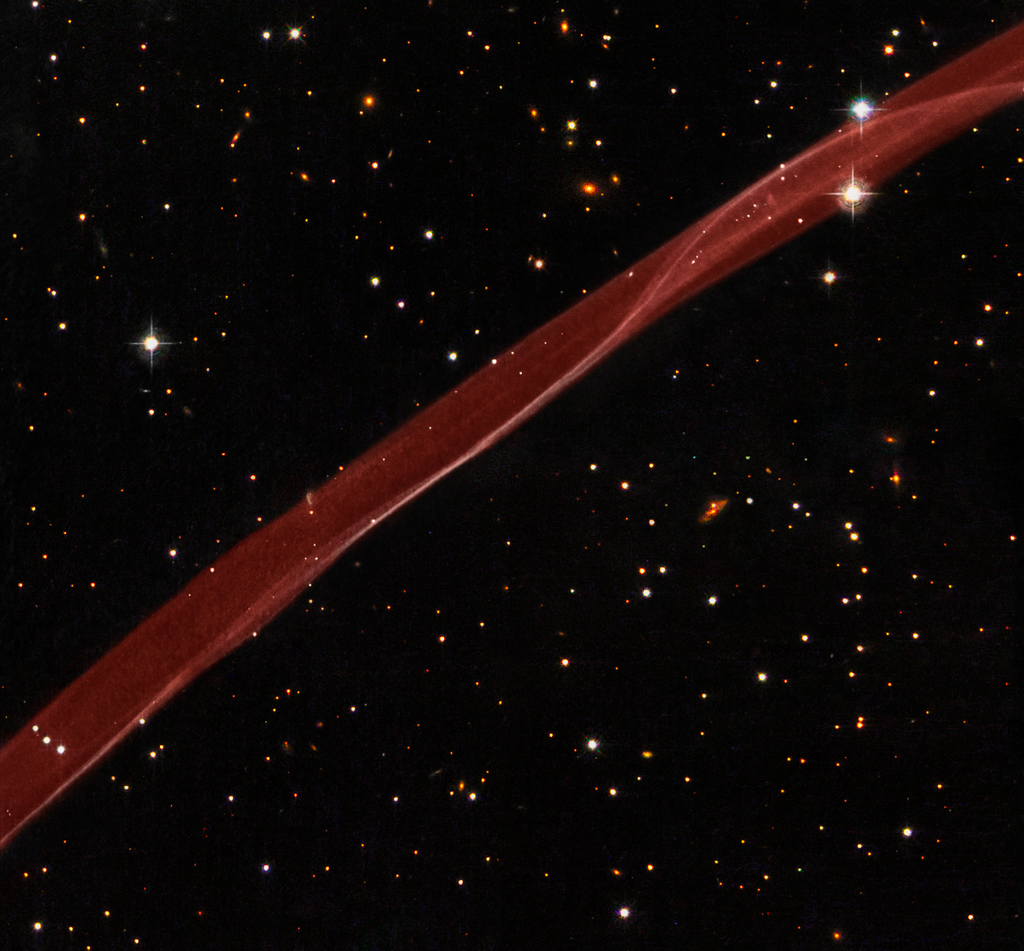
What did the telescope find?
NASA has a special space telescope called Chandra. It floats high above Earth and looks at the sky in a kind of invisible light called X-rays — the same light a doctor uses to see your bones.
Chandra spotted the glowing leftovers of a star that exploded a very long time ago, around 1,700 years back. These leftovers are called a supernova remnant, which is a fancy way of saying 'the wreckage of a blown-up star.'
What is a supernova?
When a giant star runs out of fuel, it can blow up in a huge blast called a supernova. It is one of the biggest explosions in the whole universe.
The blast throws star-stuff out into space in all directions. Over hundreds of years, this glowing cloud spreads out wider and wider, like ink slowly spreading in a glass of water.
Why does it take so long to see?
Space is enormous, and light takes time to travel across it. The light from this wreckage traveled for a very long time before it reached us.
So when Chandra takes a picture, it is a bit like looking at an old photo of something that happened long ago. We are seeing the past!
Why is this exciting?
Exploded stars are not just pretty. They scatter important materials, like the iron and other bits that go on to make new stars, new planets, and even living things.
Scientists say we are made of stardust, and they really mean it. The atoms in your body were once cooked inside stars and spread out by blasts like this one.
How does Chandra help scientists?
Because Chandra sees X-rays, it can spot super-hot gas that our eyes could never see. This helps scientists study how stars live and die.
Each new picture is like a clue. By studying the wreckage, scientists learn how the explosion happened and what the star was made of.